
Flat & Low-Slope Roof Repair in Conroe, TX
Flat Roof Repair in Conroe, TX
TPO, EPDM, modified bitumen and built-up roofs — leaks, open seams, punctures, failed flashing and ponding water, diagnosed before they are repaired.
Commercial & Residential Flat Roofs • Leak Diagnosis First • Serving Conroe, Willis, Montgomery & The Woodlands
Most flat roof repair calls in Conroe start the same way: water showing up inside. A stain spreading across a ceiling tile, a drip that only appears during heavy rain, a wet line running down a wall below a parapet, or water still standing on the roof days after the last storm. Sometimes it is a seam that has opened, a puncture from something dropped or blown across the membrane, or flashing at a wall that has pulled away.
The tricky part with a low-slope roof is that water does not fall straight through. It gets past the membrane, runs along the deck or between layers, and comes out several feet from where it actually entered. Seams, drains, pipe and HVAC penetrations, wall transitions and old patches are all common entry points, and the wet ceiling below is rarely directly under any of them.
We repair flat and low-slope roofs on homes, offices, retail buildings, shops and warehouses around Conroe and Montgomery County, and the work always starts with finding where water is getting in. For the wider picture on roof repair in Conroe TX, start there. Otherwise, call +1 (936) 299-1795 and tell us what you are seeing.
Flat Roof Problems We Repair in Conroe
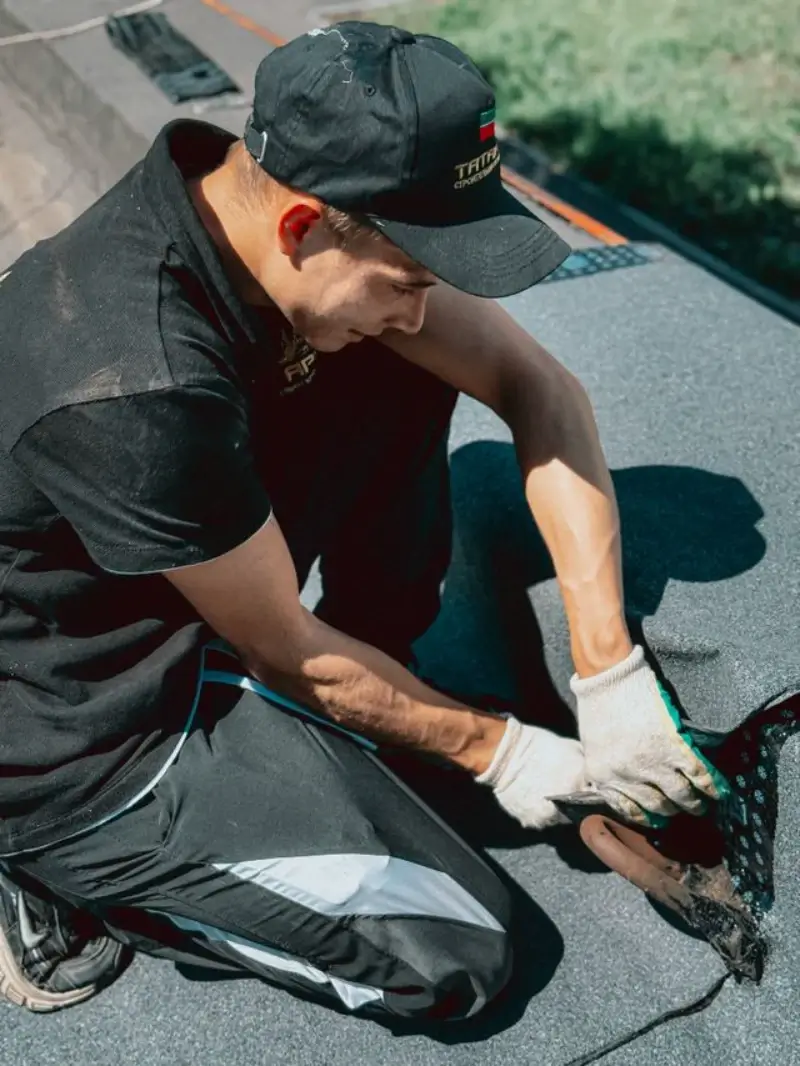
Leaks Rarely Start Where They Show Up
Flat and low-slope roofs fail in a handful of predictable places: seams, flashing, penetrations, drains, perimeter edges and old repairs. Once water gets past one of those, it travels along the deck or between layers and comes out wherever it finds a path down.
That is why we do not chase the stain. Identifying which component actually failed is what keeps a repair from turning into the same repair again next spring.
Flat Roof Leaks
Water showing on a ceiling or wall rarely sits directly under the failure. We work back from the stain to the seams, flashing and penetrations above it, confirm the entry point, then repair that detail instead of patching the wet spot.
Failed or Open Membrane Seams
A seam that has lifted at the edge, a weld that never fully bonded, or seam adhesive that has aged out lets water run under the membrane. We check the full length of the seam, not just the visible gap, then rework it for that system.
Punctures, Holes and Tears
Dropped tools, foot traffic and windborne debris open the membrane. Small holes often go unnoticed until a leak shows inside. We locate the break, check whether water has reached the insulation or deck, and repair with a compatible patch.
Flashing and Transition Leaks
Leaks along a wall, curb or parapet usually come from roof flashing or a transition detail rather than the open field of the roof, often the result of flashing deterioration over time. We check terminations, counterflashing and sealant, then rebuild the detail so water is sent back onto the membrane.
Roof Penetration Leaks
Pipes, vents, drains and HVAC curbs are the busiest spots on a flat roof. Boots crack, clamps loosen and sealant dries out. We check each penetration near the leak area and reseal or rebuild the ones that have failed.
Ponding and Standing Water
Water still sitting days after rain points to a low area, a blocked drain or a drainage path that is not working. We look at where it collects, how deep it sits and where the nearest drain is before deciding what to correct.
Soft Spots and Damaged Decking
A spot that feels soft or springy underfoot usually means moisture damage has reached the insulation or the roof decking. We open the area to see how far it spreads, replace what is damaged, then restore the roof system above it.
Failed Previous Repairs
Old patches, smeared sealant and layered coatings often cover the original problem instead of fixing it. When a leak keeps returning near a previous repair, we look underneath it to find what was never addressed.
Loose Perimeter Edge Metal
Wind works at the edges first. Lifted edge metal, open drip edge laps and torn perimeter details let water and wind get under the membrane. We refasten and reseal the perimeter so the edge holds.
Flat Roof Systems We Repair
The Repair Follows the System
A flat roof is only as good as the details on it, and every membrane type fails in its own way and gets repaired in its own way. What bonds to EPDM will not bond to TPO, and a modified bitumen repair is a different process again. Matching the repair method to the system is the difference between a fix that holds and a patch that lifts by the next season.
We work on TPO, EPDM, modified bitumen and built-up roofs, along with coated roofs where the coating itself has broken down. The approach is the same on a commercial building as it is on a flat addition over a living room: identify the system, identify what failed, then repair accordingly.
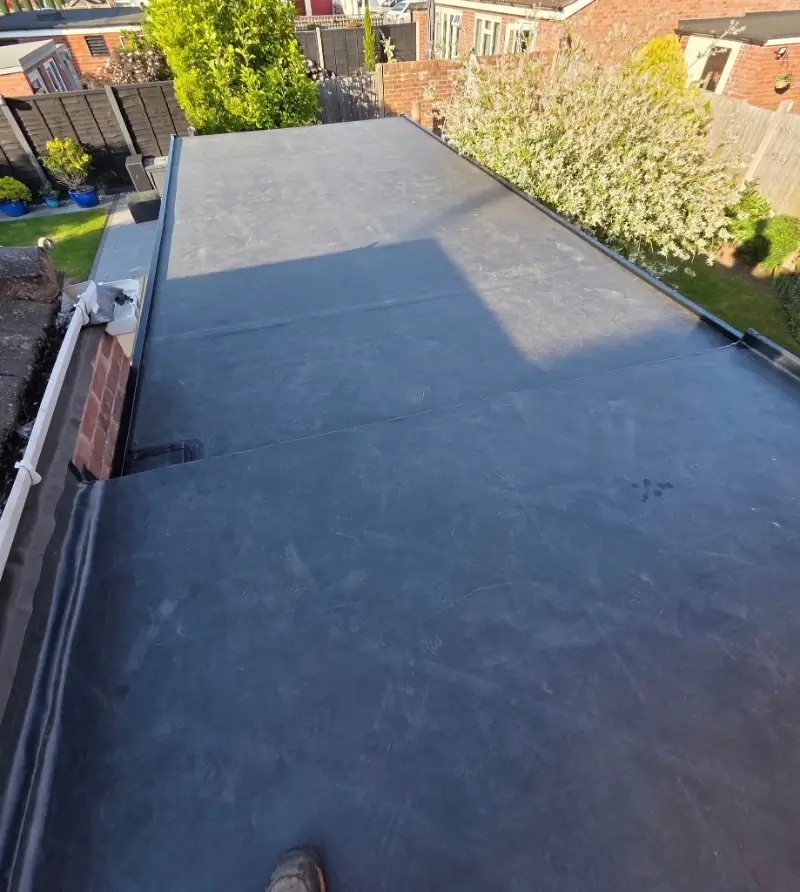
Below is how each of the systems we repair typically fails, and what a repair on that system actually involves.
TPO Roof Repair
TPO membranes are joined with heat-welded seams, and that is usually where trouble starts. A weld that ran too cool, sometimes called a cold weld, never fully bonded, and it can hold for years before opening under thermal movement. Punctures in the field of the roof are the other common issue, especially on commercial buildings that see regular rooftop traffic. Repairing TPO means getting the membrane clean and dry first, because dirt, chalking and old sealant will keep a new TPO patch from welding properly. We probe repaired welds afterward to confirm the bond instead of assuming it. Where the sheet has aged badly across a wide area, seam-by-seam repair stops making sense and the roof needs a broader evaluation.
EPDM Roof Repair
EPDM is a rubber roofing membrane, and its weak points are the seams and details rather than the sheet itself. Older EPDM roofs were joined with tape or adhesive that eventually gives up, and you will often see cover tape lifting at the edges or the EPDM membrane pulled tight at walls and curbs as it shrinks. A repair starts with cleaning and priming the area properly, since EPDM will not accept a patch over a weathered or dirty surface. From there the repair uses a system compatible with the existing membrane, whether that is new cover tape along a seam or a rebuilt flashing at a curb. Repairs made with the wrong material are one of the more common things we end up redoing.
Modified Bitumen Roof Repair
Modified bitumen roofs, sometimes called a mod-bit roof, are built in layers, and a repair usually means opening the failed area and working down through those layers until sound material is reached. Sometimes that stops at the cap sheet. Sometimes it goes to the base sheet or the deck, particularly where water has been getting in long enough to soak the insulation. The area is rebuilt with hot asphalt, base sheets and modified roll roofing suited to the existing assembly, then tied back into the surrounding roof so the laps shed water the way they should. Blisters, open laps and splits at changes in direction are what we see most often on these roofs.
Built-Up and Asphalt (BUR) Roof Repair
Built-up roofs, known in the trade as BUR roofing, are the older gravel-surfaced tar and gravel assemblies still found on plenty of commercial buildings around Conroe. Repairing one starts with clearing the loose gravel and stripping back failed felts and asphalt until the sound layers underneath are exposed. That step matters more than the patch itself, because new material laid over deteriorated felts has nothing to bond to. Once the area is sound, the roof is rebuilt in layers and the surfacing is restored. Blisters, alligatored surface asphalt and open laps around penetrations are the usual reasons we get a call on a BUR roof.
Flat Roof Coating Repairs
Coatings, whether acrylic, silicone or elastomeric, have a place, but only when the roof underneath is in condition to carry one. Coating over wet insulation, an open seam or a soft deck seals the problem in rather than solving it, and it usually shows back up within a season or two. Where the membrane is intact and the failures are limited to surface deterioration or small details, a coating repair can add usable life to the roof and make sense financially. Where the substrate is saturated or the assembly itself is failing, the honest answer is that a coating is not the right tool. We tell you which situation you are looking at before any coating work gets quoted.
Ponding Water and Flat Roof Drainage Problems
Every flat roof holds some water after a hard rain. What matters is how long it stays. Water gone within a day or two is drainage doing its job. Water still standing at the end of the week is telling you something about that roof.
Why Water Collects on a Flat Roof
It is easy to assume ponding means the roof was built without enough slope, and sometimes that is the case. More often it developed after the fact. Insulation that got wet and compressed settles into a low area. A drain sits slightly high relative to the deck around it. Debris, an old repair built up in layers, or rooftop equipment added later interrupts the path water was meant to take. On larger roofs, deck deflection between framing members does the same thing. Each of those has a different correction, which is why we do not assume a cause before getting on the roof.
How We Evaluate Ponding Areas
The useful information comes from walking the roof a day or two after rain, when you can see exactly where water is holding and how deep it is. We map the standing areas, find the deepest point, and look at how the surface falls between that point and the nearest drain or scupper. We check whether the drain is clear and whether it actually sits at the low point of the area it serves. We also inspect the membrane, seams and any old repairs inside the ponding area, because standing water finds weaknesses faster than the rest of the roof does. That is what tells us whether we are looking at a blocked outlet, a settled low spot, or a drainage problem across a larger section.
Correcting the Drainage Problem
The correction depends entirely on what the evaluation turned up. A clogged drain or scupper is straightforward. A localized low area can often be built back up so water moves toward the drain instead of sitting in place. A drain set too high, or one where the surrounding membrane and clamping ring have failed, is repaired at the drain itself. Where the low area comes from wet or compressed insulation, the assembly under the membrane has to be opened and dealt with before any surface work will hold. There is no single technique that fits every ponding situation, and the right one only becomes obvious after the cause is identified.
Emergency Flat Roof Repair in Conroe
Some flat roof problems can wait for a scheduled visit. Others cannot. Water running into a building during rain, a membrane opened up by a storm, a section lifted at the perimeter, or a leak coming down into an occupied office, retail floor or warehouse with stock underneath all need eyes on the roof sooner rather than later.
What Counts as an Emergency
Active dripping during or after rain, water spreading across a ceiling grid, a leak running down an interior wall or near electrical, a visible opening in the membrane after a storm, or debris that has punched through the roof surface all count as an emergency roof leak. On a commercial building, water landing on inventory, equipment or a production area moves the situation up the list regardless of how large the opening turns out to be. Damage that arrived with a storm often overlaps with broader storm damage roof repair work.
Stabilizing Comes Before the Final Repair
Emergency work and permanent repair are two different jobs, and it helps to know that going in. The first priority is limiting water intrusion: finding where water is entering, interrupting that path, and protecting what is underneath. Depending on the weather and the condition of the roof, that may be a temporary measure. The permanent repair follows once the area can be properly prepared, dried and repaired in a way that will actually hold. Trying to complete a final repair on a wet membrane in the middle of a storm is how repairs fail twice.
What Happens on an Emergency Call
- Confirm what you are seeing inside and where it is happening.
- Get on the roof and find the damage or opening connected to it.
- Identify the likely water path from the roof surface to where it is showing.
- Stabilize the area to limit further water entry.
- Assess what the full repair will involve once the roof can be worked properly.
- Schedule and complete the permanent repair.
Some situations get resolved in a single visit. Others need protection first and the permanent repair afterward. Which one applies depends on the roof, the extent of the damage and the conditions at the time. Call +1 (936) 299-1795 and describe what is happening, and we will tell you honestly whether it needs to be looked at today.
Commercial Flat Roof Repair in Conroe
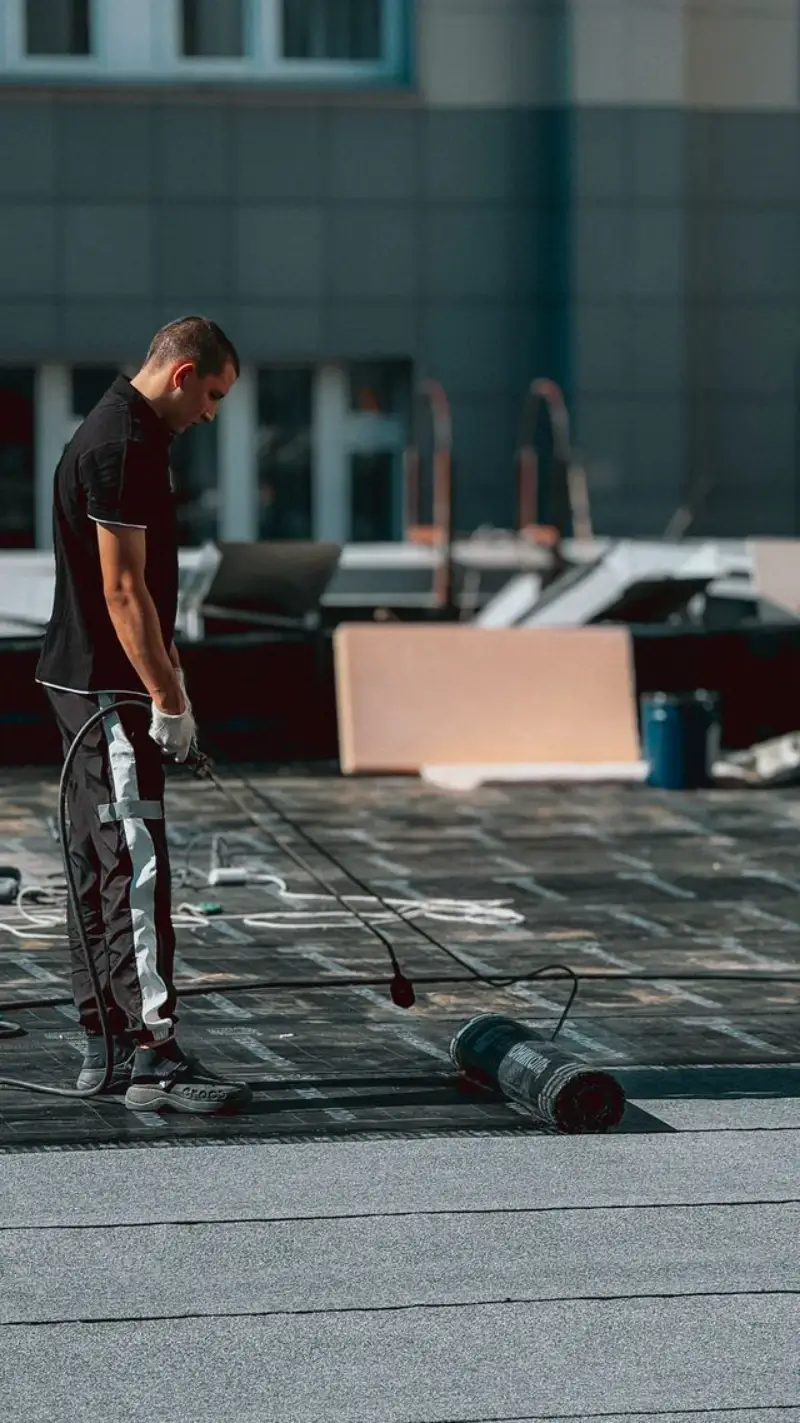
Repairs on an Occupied Building
Commercial flat roofs are larger, busier and harder to diagnose than residential ones. A single roof might carry rooftop HVAC units, exhaust fans, gas lines, conduit, dozens of penetrations and several hundred feet of seam. Any one of those can be the reason water is coming through a ceiling tile in an office two bays over, a common commercial roof leak pattern on larger commercial roofing systems.
There is also the building itself to work around. People are working underneath, and a repair that shuts down half a floor is not much of a repair. We plan access, staging and the order of the work so the roof gets fixed with as little disruption below as possible. For work outside the flat roof scope, we also handle general commercial roof repair in Conroe TX.
Office and Retail Flat Roof Repair
On offices and retail buildings the first sign is almost always a ceiling tile. Someone reports a stain or a drip, and by the time it gets called in the water has usually been getting in for a while. These roofs tend to have a lot of small penetrations, including vents, conduit and old units that were removed and curbed over, and leaks cluster around them. Rooftop service traffic is another factor: crews walking the same route to an HVAC unit compress insulation and wear the membrane over time. We start at the reported location and work outward through the details in that section of roof instead of resurfacing the whole thing.
Warehouse and Industrial Flat Roof Repair
Warehouse roofs cover a lot of ground, which changes how you go after a leak. Large uninterrupted membrane fields mean long seam runs, and one open lap can carry water a considerable distance before it drops through. Skylights, exhaust units, roof drains and expansion joints are the details that come up most often. What is stored underneath matters too: a slow leak over racking, electrical or production equipment is worth treating more urgently than the same leak over an empty aisle. We coordinate access and sequence the work so the repair happens without shutting the floor below down.
Residential Flat and Low-Slope Roof Repair
Not every flat roof in Conroe is on a commercial building. Plenty of homes here have a low-slope section somewhere: a flat addition over a back room, a porch or patio cover, a garage roof, or a nearly level section framed between two pitched roofs. Those areas leak for the same reasons commercial roofs do, and residential flat roof repair usually gets less attention until a leak forces the issue.
The problems are predictable. Water sits on the low-slope section because it drains slowly. The transition where the flat area meets the pitched roof or a wall was never flashed well, or the flashing has since pulled loose. An old patch on a porch roof has cracked and opened. Some of these low-slope sections are metal panel rather than membrane, and those get handled as metal roof repair instead.
The approach does not change: find where water is entering, repair that detail, then check what surrounds it. Work on the pitched portions of the house is covered under residential roof repair in Conroe TX.
How We Find the Source of a Flat Roof Leak
Finding It Before Repairing It
You cannot repair a flat roof leak properly until you know where water is entering, and on a low-slope roof that is almost never directly above the stain. Water gets under the membrane, runs along the deck, follows a seam or a piece of framing, and drops through wherever it finds an opening in the ceiling below.
So the first part of any repair is a search, and it runs in a fairly consistent order. Below is how we work through it on a repair call. If the whole roof needs evaluating rather than one leak, that is a separate roof inspection.
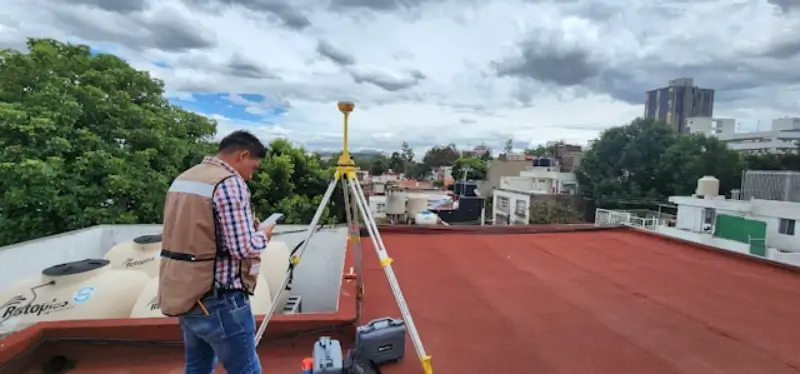
Start With Where the Leak Is Showing Inside
The interior tells you more than people expect. Which room, which side of the building, whether it drips during rain or hours afterward, whether it is one spot or several, and whether it started after a particular storm. A leak that only shows during heavy sustained rain behaves differently from one that shows in a light shower. We also look at what is directly above the ceiling, since framing, ductwork or conduit can carry water sideways before it ever drops.
Trace the Roof Area Above and Around the Leak
From the interior location we work out the corresponding area on the roof, then widen out from there. That means walking the membrane and looking for anything out of place: a blister, a scuff or cut, a repair somebody made before, a low area holding water, or a stretch where the membrane simply looks different from what surrounds it. On a large commercial roof this is the step that takes the longest, and skipping it is how people end up repairing the wrong thing.
Check Seams, Flashing and Transitions
Seams get checked along their length, not just where a gap is obvious. A lifted edge of cover tape, a weld that has opened an inch, or an end lap that was never properly sealed is enough to account for a leak. Flashing at walls, curbs and parapets gets the same treatment, including terminations, counterflashing, sealant condition and whether the flashing is still fastened where it should be. Transitions where the flat roof meets a wall, another roof plane or a different material are consistently among the most likely spots.
Check Penetrations, HVAC Curbs and Drains
Anything that comes through the membrane is somewhere water can come back in. Pipe boots crack and clamps loosen. Vent flashings pull away. HVAC curbs leak at the corners or where the unit sits on them. Drains leak at the clamping ring or where the membrane has torn around the bowl. Scuppers leak where the sleeve meets the wall. We check each of these in the area that could reasonably be feeding the leak rather than assuming the nearest one is the culprit.
Look Beyond Previous Patches
When a roof already carries repairs, the leak is frequently connected to one of them. Either the patch failed, or it never addressed the actual source to begin with. Sealant smeared across a seam and coating rolled over a wet area are the two we run into most. We look underneath previous repairs rather than adding another layer on top, because a patch over a patch does not solve anything and makes the next repair harder to do properly.
Our Flat Roof Repair Process
How a Flat Roof Repair Actually Goes
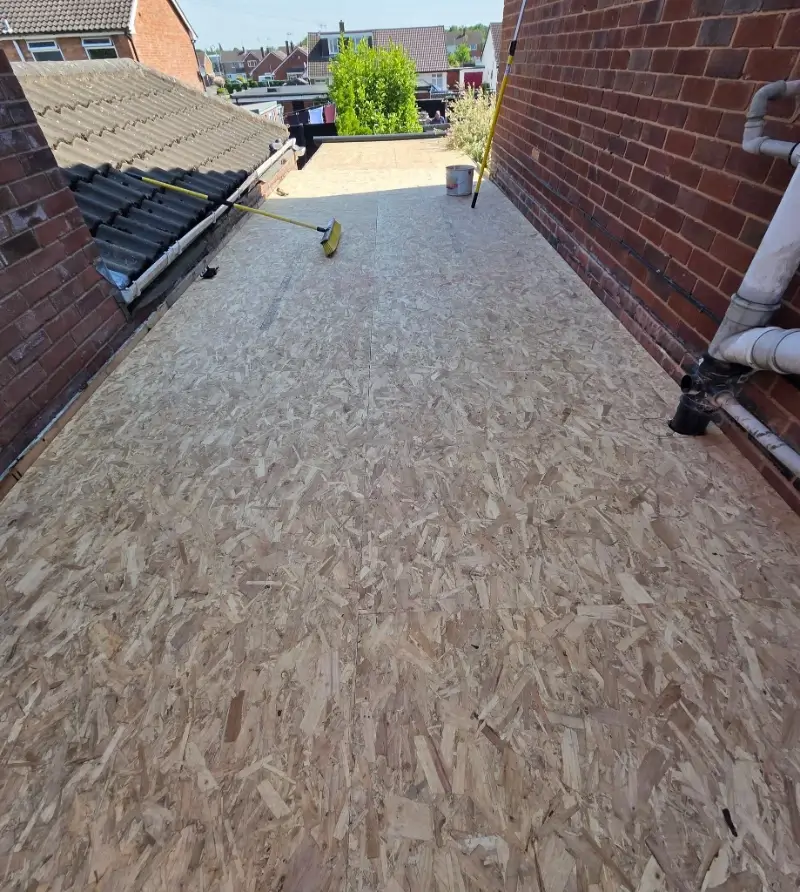
Every repair runs through the same six steps, whether it is a single puncture on a house addition or a run of failed seam on a warehouse roof. The scale changes. The order does not.
Working this way keeps one thing straight: the repair gets decided after the failure is identified, not before. That is what keeps you from paying for work the roof did not need, and from paying twice for work that never addressed the cause.
Confirm the Problem Area
We start with what you reported and narrow down where water could realistically be entering, since it travels under a low-slope membrane before it ever shows up inside.
Identify the Failure
Seam, puncture, flashing, penetration, drain or decking. We work the details in that section of roof until we find the one actually letting water through, then check what is around it.
Determine the Appropriate Repair
The membrane type, the size of the failure and the condition of what sits underneath decide the repair. A localized fix and a section rebuild are different jobs, and we tell you which one it is.
Prepare the Repair Area
This is where repairs are won or lost. Loose gravel and failed material come off, the surface is cleaned of dirt, chalk and old sealant, and the area is dried. Nothing bonds to a wet or contaminated surface.
Complete the System-Specific Repair
A TPO weld, EPDM cover tape, modified bitumen layers, BUR felts and asphalt, a rebuilt flashing detail or a drainage correction, using materials compatible with the existing roof.
Check and Verify the Repair
We probe welds and seam edges, inspect the details surrounding the repair, and look at how water will move off the area. Not every leak can be water-tested on the spot, but what can be confirmed is confirmed.
Can a Flat Roof Be Repaired Without Replacing It?
Repair Is the Usual Answer
In most cases, yes. A flat roof leaking in one or two places, with the rest of the membrane in reasonable shape, is a repair. That describes the large majority of the calls we take. Replacement enters the conversation when the problems stop being localized.
What decides it is not the age of the roof on its own, and not how bad the leak looks from inside. It is how much of the roof is involved, and whether the insulation and deck under the membrane are still dry and sound.
When a Localized Repair Makes Sense
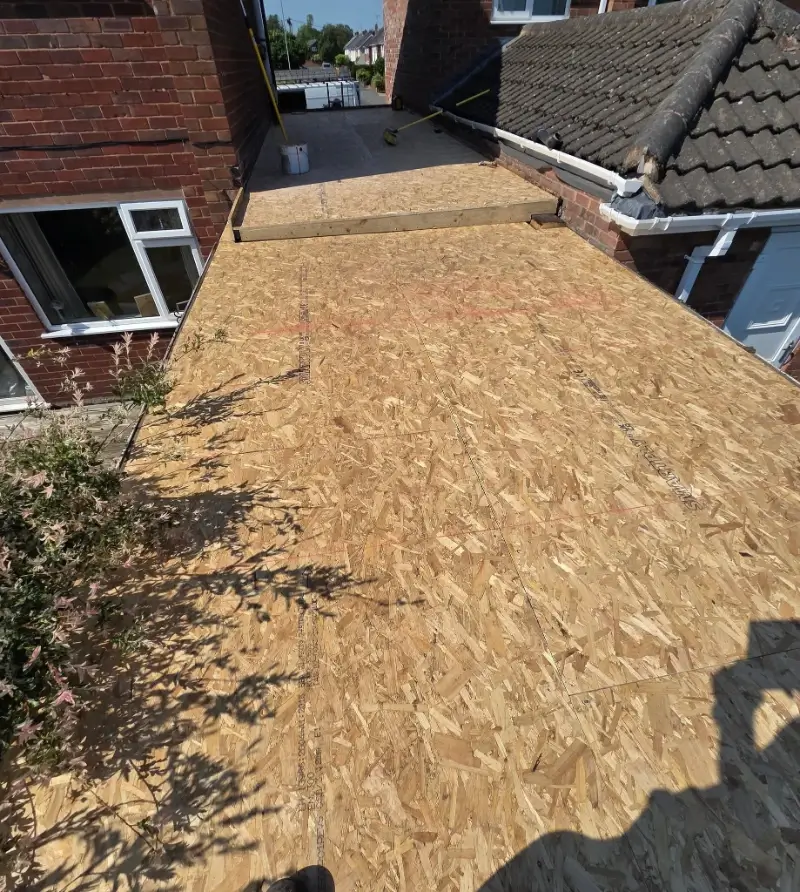
A puncture or tear in an otherwise sound membrane. A single seam that has opened. Flashing that has pulled loose at one wall or curb. A drain leaking at the clamping ring. A soft area over one small section of decking. In each of those the failure is confined, the surrounding roof is still doing its job, and repairing the specific detail solves the problem. Age by itself does not rule this out. Plenty of older roofs get repaired successfully because the failures are in the details rather than across the field.
When Broader Work Needs Looking At
Leaks appearing in several unrelated areas of the same roof. Membrane that has aged to the point of cracking or splitting across the field rather than at one spot. Wet insulation you can feel underfoot over a large area. Multiple failed repairs stacked on each other. Seams opening in more than one place at once. When that is the picture, repairing a single spot buys a short reprieve and the next leak turns up somewhere else. At that point it is worth evaluating the roof as a whole and weighing roof replacement against the cost of continuing to repair.
That is not a call we make from a phone description. It comes after somebody has been on the roof and seen what is under the membrane.
Flat Roof Repair vs. Roof Coating vs. Replacement
Repair, coating and replacement are not competing products. They are three different responses to three different roof conditions, and the condition decides which one applies. The table below shows the direction each situation usually points, though the same symptom can come from more than one cause and only an inspection can confirm which applies to a particular roof.
Notice that none of these are absolutes. A roof with widespread deterioration might still be a candidate for restoration rather than a full tear-off, and a roof with repeated leaks might turn out to have one shared cause. That is what an evaluation is for.
Flat Roof Repair for Conroe Weather Conditions
Flat roofs around Conroe work in conditions that are hard on low-slope roofing specifically: long stretches of heat, rainfall that arrives fast and heavy, and storms that bring wind and debris with them. Each of those puts pressure on a different part of the assembly.
Heat and UV Exposure
Summers here run hot and long, and a flat roof takes the full load of that Texas heat because there is nowhere for the sun to fall away to. Membranes age faster under sustained UV, particularly older single-ply that has lost its surface, a common form of membrane deterioration. Sealants at penetrations and terminations dry, shrink and crack. Daily heating and cooling makes the assembly expand and contract, and that movement concentrates at transitions and seams, which is exactly where welds and adhesives are being asked to hold. A good share of the seam and flashing failures we repair started as heat-driven movement over several seasons rather than a single event.
Heavy Rain and Drainage
When it rains here it often rains hard and fast. A flat roof has to move a large volume of water in a short window, and anything interrupting that path shows up right away. Drains and scuppers partly blocked with debris back water up. Low areas that would drain slowly under a steady rain simply hold it. Standing water then sits on seams and old repairs and works at them, and it adds weight where the deck may already be deflecting. That is why drains are the first thing we ask about on a ponding call.
Wind and Storm Damage
Storm wind goes after the perimeter and anything raised above the roof surface. Edge metal lifts, drip edge laps open, and once wind gets under an edge it can peel membrane back from there. Debris carried across the roof punctures and tears the surface, sometimes in spots nobody notices until a leak shows inside. Equipment screens, sign supports and rooftop units take damage at their attachment points. If a flat roof took damage during a hail event, that falls under hail damage roof repair, and it is worth having looked at even when nothing is leaking yet.
Where Flat Roofs Commonly Leak
After enough of these, the list of places to check gets fairly short. These are the details we go to first when a flat roof is leaking, roughly in the order they come up.
Membrane seams — where two sheets join is the single most common leak point on a flat roof, especially at end laps.
Previous repairs — old patches and smeared sealant often cover the original failure instead of correcting it.
Wall transitions — where the flat roof meets a wall, water gets behind the detail once the termination loosens.
Flashing — base flashing and counterflashing at curbs and parapets crack, pull away or lose their sealant.
HVAC curbs — the corners of a curb and the joint where the unit sits on it are frequent entry points.
Roof vents — vent flashings work loose and the sealant around them dries out and splits.
Pipe penetrations — boots crack with age and clamps back off, leaving a gap around the pipe.
Roof drains — leaks show at the clamping ring or where the membrane has torn around the drain bowl.
Scuppers — the sleeve through the wall separates from the membrane or from the wall flashing above it.
Perimeter edges — lifted edge metal and open drip edge laps let wind and water under the membrane.
Parapet details — caps, joints and the back side of a parapet wall are easy to overlook and leak often.
Punctured membrane — dropped tools, dragged equipment and windborne debris open the surface anywhere on the roof.
If a leak is showing up somewhere in your building and you are not sure which of these is behind it, call +1 (936) 299-1795 and we will get on the roof and find it.
Flat Roof Repair Cost in Conroe, TX
We do not publish flat roof repair prices, and any roofer who quotes one before seeing the roof is guessing. Two leaks that look identical from inside can turn out to be a short repair and a two-day repair depending on what is under the membrane.
These are the things that actually move the number:
The roofing system on the building — TPO, EPDM, modified bitumen, built-up or coated
Where the leak is actually coming from, and how long it takes to find it
The size of the repair area once the failure is opened up
Roof access, and how materials and equipment have to be staged
Whether it is a seam repair, a flashing repair or a penetration repair
Whether the insulation or decking underneath has been damaged
Whether drainage has to be corrected as part of the work
Emergency response versus a scheduled visit
How far storm damage extends across the roof
The most useful estimate comes after the repair area and the underlying cause have been identified. That is usually a short visit, and it puts a real figure in front of you instead of a range that means nothing. Call +1 (936) 299-1795 and we will come look at it.
Preventing Repeat Flat Roof Leaks
Most repeat leaks are not bad luck. They come from the same handful of things going unaddressed long enough for water to find them again, which is why routine roof maintenance matters as much as the repair itself.
Keep drains, scuppers and gutters clear, particularly heading into the wetter part of the year
Have punctures and tears repaired when they happen rather than when they start leaking
Watch the areas that have been repaired before, since those are the ones that tend to come back
Keep rooftop traffic down and use walkway protection along regular service routes
Walk the roof after major storms and look for debris, lifted edges and new damage
Do not write off a stain that dried out — the leak did not necessarily go with it
Address seams and flashing that are visibly deteriorating before water finds them
Have the roof looked at periodically instead of waiting for the next leak to force it
A periodic roof inspection catches most of this while it is still a small item, which is a good deal cheaper than dealing with wet insulation and a soft deck later on.
Why Choose Roof Repair Conroe TX for Flat Roof Repair in Conroe?
Local, and Flat Roofs Are Part of the Regular Work
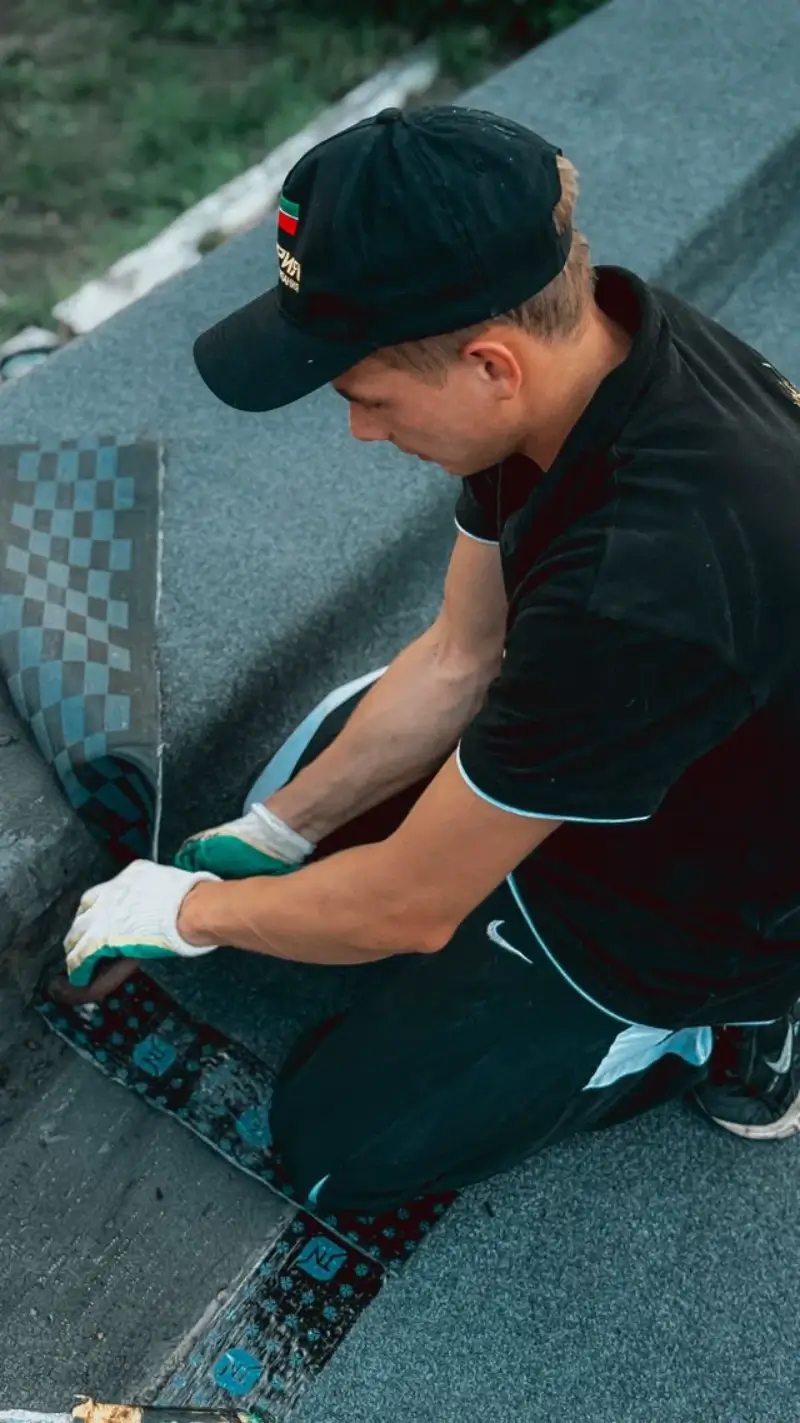
Roof Repair Conroe TX works out of 175 Circle 6 Dr in Conroe as a local flat roof contractor, and flat and low-slope roofs are a regular part of what we do rather than something we take on occasionally. That covers TPO, EPDM, modified bitumen and built-up systems on commercial buildings, along with the low-slope sections on houses around the area.
The approach does not change from job to job: inspect and diagnose first, then repair what actually failed. We are reachable Monday through Friday 7am to 5pm and Saturday 7:30am to 4pm at +1 (936) 299-1795.
Based in Conroe
We work out of 175 Circle 6 Dr in Conroe and cover Montgomery County, so a flat roof call here is a local drive rather than a scheduling problem.
Diagnosis Before Repair
We find where water is entering before deciding on a repair. That is the step that keeps the same leak from showing back up next season.
Multiple Flat Roof Systems
TPO, EPDM, modified bitumen, built-up and coated roofs. The repair method gets matched to the system already on the building.
Commercial and Residential
Warehouses, offices and retail buildings, along with flat additions, porch covers and low-slope sections on homes around Conroe.
Leak and Drainage Work
Seams, flashing, penetrations, punctures, drains and ponding areas. Drainage gets treated as its own problem instead of being patched over.
Straight Answers
Reachable Mon–Fri 7am–5pm and Sat 7:30am–4pm at +1 (936) 299-1795. If the roof needs more than a repair, we will say so.
Flat Roof Repair in Conroe and Nearby Areas
Most of our flat roof work is in Conroe itself, on commercial buildings, shops and homes with low-slope sections, with regular calls throughout the surrounding Montgomery County communities listed above. If you are in or near one of them, call +1 (936) 299-1795 and we will let you know what we can schedule.
Flat Roof Repair FAQs
Can a Leaking Flat Roof Be Repaired Without Replacing It?
In most cases, yes. When the leak comes from a specific failure such as an open seam, a puncture, loose flashing or a bad drain detail, and the rest of the membrane is still in reasonable shape, repairing that detail solves the problem. Replacement becomes the better conversation when leaks are showing in several unrelated areas, the insulation is wet across a broad area, or the membrane is deteriorating across the field rather than at one spot.
What Causes a Flat Roof to Leak?
Usually a failed detail rather than the membrane itself giving out. Seams that have opened, punctures from tools or windborne debris, flashing that has pulled loose at a wall or curb, cracked pipe boots, leaking drains and scuppers, and old repairs that never addressed the real source. Standing water accelerates all of it by sitting on those weak points instead of running off the roof.
Where Do Flat Roofs Usually Leak?
At the details. Membrane seams and end laps, transitions where the roof meets a wall, flashing at curbs and parapets, HVAC curbs, vents and pipe penetrations, roof drains and scuppers, perimeter edge metal, and anywhere a previous repair was made. The open field of the membrane leaks far less often, and when it does it is usually a puncture rather than a material failure.
Can Ponding Water on a Flat Roof Be Repaired?
Often, but the correction depends on why water is sitting there. A blocked drain or scupper is a straightforward fix. A settled low area may be built back up so water moves toward the drain. A drain set too high, or one with failed membrane around the clamping ring, is repaired at the drain itself. Where wet or compressed insulation created the low spot, the assembly underneath has to be opened before any surface work will hold.
Can a TPO Roof Be Repaired?
Yes. Most TPO problems are seam-related or punctures in the field, and both are repairable. The repair involves cleaning and drying the membrane thoroughly first, since dirt, chalking and old sealant will keep a new weld from bonding, then heat-welding the repair and probing it afterward to confirm the bond. Where the sheet has aged badly across a wide area, a broader evaluation makes more sense than repeated seam repairs.
Can an EPDM Flat Roof Be Repaired?
Yes. EPDM problems tend to be at the seams and details rather than in the rubber itself, and both are repairable. Cover tape that has lifted, adhesive that has aged out, and flashing pulled tight at a curb by membrane shrinkage are the usual ones. The area has to be cleaned and primed correctly, and the repair has to use materials compatible with EPDM. Repairs made with the wrong product are a common reason we get called back to a roof.
Can Modified Bitumen Roofs Be Repaired?
Yes. Modified bitumen is built in layers, so the repair generally means opening the failed area and working down until sound material is reached, then rebuilding with hot asphalt, base sheets and modified roll roofing suited to the existing assembly. Blisters, open laps and splits at changes in direction are the common failures. How far down the repair goes depends on whether water has reached the insulation or the deck.
How Do Roofers Find Leaks on Flat Roofs?
By working from the inside out. We start with where the water is showing, when it shows and what sits above the ceiling, then move to the corresponding area of the roof and widen out from there. Seams, flashing, transitions, penetrations, curbs and drains all get checked, along with any previous repairs. On larger roofs the search takes longer than the repair itself. If the whole assembly needs assessing rather than one leak, that is a roof inspection.
How Much Does Flat Roof Repair Cost in Conroe?
It depends on the roofing system, where the leak is actually coming from, how large the repair area turns out to be once it is opened, roof access, and whether insulation or decking underneath has been damaged. Drainage corrections and emergency response affect it as well. We do not quote flat roof repairs over the phone, because the real number only appears after the failure has been located. Call +1 (936) 299-1795 and we will come look at it.
Should I Repair or Replace My Flat Roof?
If the failures are localized and the rest of the roof is sound, repair. If leaks are appearing in several unrelated places, the insulation is wet across a large area, or the membrane is cracking and splitting across the field rather than at one spot, it is worth evaluating the roof as a whole. Age alone does not settle it. Plenty of older roofs get repaired successfully because the problems are in the details.
Do You Repair Commercial Flat Roofs in Conroe?
Yes. Offices, retail buildings, shops, warehouses and industrial buildings, on TPO, EPDM, modified bitumen and built-up systems. Commercial roofs bring their own complications: rooftop equipment, long seam runs, a lot of penetrations, and people working underneath. We plan access and sequence the work to keep disruption to the building below as low as we can while the repair gets done properly.
Do You Provide Emergency Flat Roof Leak Repair?
Yes, for situations where water is actively getting in: a storm-created opening, membrane peeled back at an edge, or a leak coming down into occupied space or over inventory and equipment. The first priority is finding the water path and limiting further intrusion. Depending on the weather and the condition of the roof, the permanent repair may follow once the area can be properly prepared and dried.
What areas do you serve for flat roof repair near Conroe, TX?
We repair flat roofs throughout Conroe, TX, including ZIP codes 77301, 77302, 77303, 77304, 77305, 77306, 77384, and 77385, and in nearby communities such as The Woodlands, Willis, Montgomery, Magnolia, and Shenandoah.
Need Flat Roof Repair in Conroe, TX?
If a flat roof is leaking, holding water days after rain, or came out of the last storm with damage on it, the first job is working out what actually failed. From there the repair is straightforward: prepare the area properly and fix the detail with materials that match the system already on the building. We handle flat and low-slope roof repair on commercial buildings and homes across Conroe, Willis, Montgomery, The Woodlands, Magnolia and Shenandoah, including emergency work when water is coming in right now. Call and tell us what you are seeing, and we will get on the roof and give you a straight answer.